Home · Guides · Second Brain for Business
DefinitionWhat is a second brain for business?
This is the definition. How we put one to work inside a company is on the Adopt page.
A second brain for business is one clean, AI-readable memory layer that holds what the company actually knows (its offers, tone of voice, policies, decisions, and SOPs), so that humans and AI agents stop working from scattered context. A pile of documents is storage; a second brain is curated, classified, and tested. Once it exists, every AI tool the business touches stops being generic, because it finally has the context only a few long-tenured people used to carry. At Helix it is one of the tools we use inside Adopt and Partner, when the diagnostic shows a team needs it. You don't have to imagine one: the demo brain is live and fully explorable.
Where it fits: a second brain is a means, not the starting point. At Helix every engagement starts with the diagnostic, and most of the work after it is getting teams using the AI tools they already pay for. A second brain gets built when those tools keep producing generic work because nothing tells them how the company operates. Our own company runs on one.
 By Jay Oswal, Founder, Helix AI · October 2026
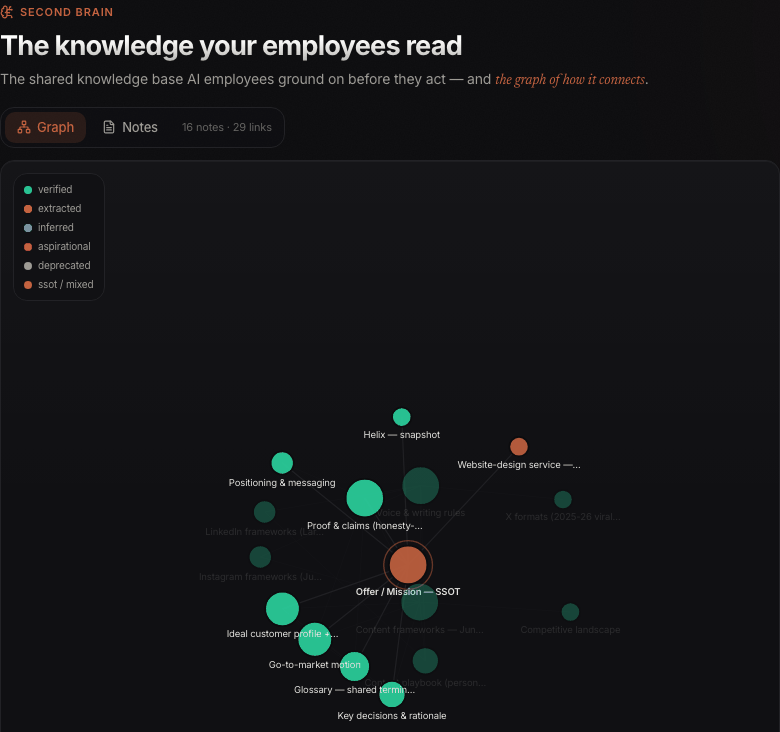
Every note our agents read before they act. Open the live graph in the demo.
Why growing companies need one
In most companies of 50 to 300 people, the real knowledge lives in a few heads: the founder, the longest-serving operations lead, the account manager who has been there since the first customer. What the offer actually includes, how the brand talks, which customers get exceptions, why last quarter's pricing decision went the way it did. Fragments of it sit in email threads, Teams or Slack, and a shared drive nobody has opened since onboarding. Almost none of it exists in a form a new hire, or an AI tool, can actually use.
That is why AI feels generic inside most companies. Copilot or ChatGPT drafts emails in nobody's voice. A support bot quotes the wrong policy. Every tool starts from zero, every session, because there is nothing for it to read. Agents without memory are generic demos, and the fix is not a better model. It's memory. Give the same tools one clean context layer and they stop guessing.
What goes in and what never does
A second brain is deliberately narrow. Six kinds of knowledge earn a place:
- Offers. What's included, what's excluded, pricing logic, guarantees.
- Tone and voice. How the brand writes, what it sounds like, the words it never uses.
- Policies. Refunds, exceptions, escalation rules: the calls that today only one or two people can make.
- Customer knowledge. Who the business serves, the segments, the recurring objections, never individual customer records.
- Decisions. What was decided and why, so it isn't relitigated every quarter.
- SOPs. How recurring work actually gets done, not how the old wiki says it does.
What never goes in: credentials, legal documents, personal data, and customer PII. Every entry is classified public, internal, confidential, or restricted, and restricted material never enters the brain. It is classified out at the diagnostic stage, before anything gets written.
How this differs from a Notion dump
Most businesses will say they already have documentation. Usually they have storage: a pile of pages that grew by accretion, where nobody can tell what's current, what's sensitive, or where a claim came from. A second brain is the opposite of a dump on four counts:
| A document dump | A second brain |
|---|---|
| Accumulates everything ever written | Curated: holds only what is still true |
| No sensitivity model; anything can read anything | Classified public, internal, confidential, restricted |
| No provenance | Sourced: every entry traceable to where it came from |
| Assumed useful | Tested against real tasks before sign-off |
The test is concrete. Before a build is signed off, it has to beat a cold run: the same task performed by an AI with the brain and without it, on the client's own work. If the brain doesn't win, it isn't done. The demo brain (eight branches, live on this site) shows what the finished artifact looks like; the cold-vs-brain comparison is demonstrated there too.
Where it fits in an engagement, and what it costs
- Diagnose. $5,000, credited in full to Adopt. Two to three weeks: a kickoff with leadership, 5 to 8 recorded interviews with the people who do the work, then a readout presented live with 2 to 3 working demos and every step priced. This is where we find out whether scattered knowledge is what's holding AI back, or whether something else is. If the readout does not map at least $10K of recoverable value, full refund. You keep the roadmap either way.
- Adopt. Priced in the readout. Mostly setting up and training teams on the AI tools you already pay for: Microsoft 365 Copilot, Gemini for Google Workspace, ChatGPT, Claude. A second brain gets built here when those tools need company context they can't get any other way. There are no integrations to approve and no platform permissions to wait on, and it ships with a trained owner on your team.
- Sign-off against the cold run. The brain has to beat the no-brain baseline on your own tasks before handoff.
- Partner. 12 months, priced in the readout. We run it with you: a monthly adoption check, a return report against the baseline set in the diagnostic, tuning, new workflows, and a re-diagnosis every quarter, so the brain stays true as the business moves.
The ladder is one line: Diagnose, Adopt, Partner. Two founding diagnostic slots are open at $2,500, in exchange for a named case study. You own everything we build, the brain and its contents, no lock-in. Every AI agent added later plugs into the same brain, which is how it becomes part of a full AI operating system. Prices are on the pricing page.
Who it's for and who it isn't
The fit is companies of 50 to 300 people where knowledge is spread across teams and a few long-tenured people: the company knows more than any one document says, and every AI tool needs that context before its output is usable. The person who feels it is usually the CEO, COO or head of operations, the one who sees the same question answered five different ways.
And an honest exclusion: if your team's AI tools already produce on-brand, on-policy work, or the knowledge that matters fits in a few documents you actually keep current, a second brain is overhead. Skip it and spend the money on adoption instead. It pays for itself where knowledge is scattered across heads and tools, and the same context gets repeated (to people and to AI) every week.
Common questions
Start with the demo, then the diagnostic
The fastest way to judge the idea is to open a finished brain and click around. To find out whether your company needs one, or whether the AI tools you already own would do the job once they are set up, start with the diagnostic: two to three weeks, $5,000, credited in full to Adopt.